 Proudly Canadian
Air duct cleaning: when it is worth doing, how it should be done, and what it will not fix
CentFix
Updated regularly · Canada-wide
Duct cleaning is one of the more oversold home services, which is unfortunate because there are situations where it genuinely matters. This guide separates those situations from the marketing, explains what a proper cleaning involves, and covers what to check before booking.
CentFix is a matching service. You describe the job once and we connect you with independent duct cleaning companies who serve your address. Licensing, insurance, warranties and reviews belong to the individual businesses that earned them. We route the request, they do the work.
Everything below applies to homes across Canada. It covers scope, what pushes a price up or down, realistic timelines, the rules that apply, seasonal factors, and the questions worth asking before anyone starts.
What duct cleaning actually includes
A proper cleaning connects a high-capacity vacuum to the duct system to put it under negative pressure, then agitates each run with brushes or compressed-air tools so debris is pulled toward the collection point rather than blown into rooms. Supply runs, return runs and the main trunk all get treated.
The equipment side of the furnace matters too. The blower compartment, evaporator coil area and the cabinet itself collect dust, and cleaning ducts while ignoring the air handler leaves the dirtiest part of the system untouched.
There are moments when this is clearly worthwhile: after renovation or drywall work, after a rodent or insect problem, when moving into a home with unknown history, when there is visible mould or debris, or when the system has never been cleaned in decades. Routine annual cleaning of a clean system is not necessary.
- Supply and return duct cleaning with negative pressure equipment
- Main trunk and branch line cleaning
- Register and grille cleaning
- Blower compartment and air handler cleaning
- Dryer duct cleaning as an add-on service
- Post-renovation dust and debris removal from ductwork
What drives duct cleaning costs up or down
The number of duct runs is the main measure, which is why companies ask how many registers you have. Larger homes with more branches take longer and cost more.
System type and access matter. Flexible ductwork requires gentler handling than sheet metal, and ducts in tight crawl spaces or finished ceilings take longer to reach.
Add-ons make up the rest: dryer vent cleaning, blower compartment service, sanitising treatments and any repairs to disconnected or damaged duct sections found during the work.
- Number of supply and return runs in the system
- Home size and duct accessibility
- Duct material, with flexible duct requiring careful handling
- Whether the air handler and blower are included
- Dryer vent cleaning added to the same visit
- Repairs to damaged or disconnected duct found during cleaning
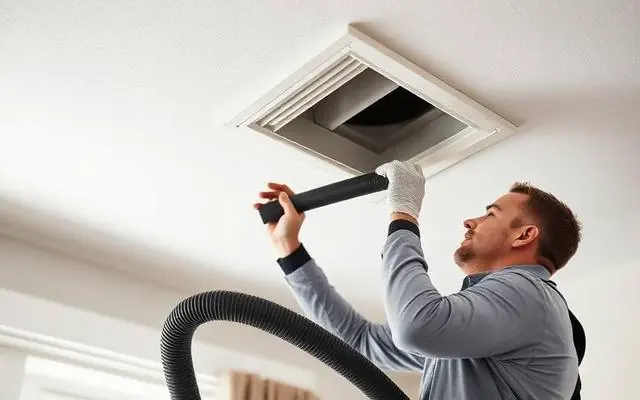
Describe the job once and independent duct cleaning companies who service your address will come back with quotes you can compare.
How long duct cleaning work takes, and how soon someone can come
A typical home takes two to four hours depending on the number of runs. Larger homes and systems with multiple zones take longer.
Booking is heaviest in early autumn as heating season approaches and in spring. Post-renovation cleaning should be scheduled after all dusty work is finished, not partway through.
How to choose the right duct cleaning technician
The strongest filter is asking what equipment is used and whether the whole system is included. Companies working from a small portable vacuum and cleaning only the supply registers are not doing the job the price implies.
Be direct about very low advertised prices. The pattern in this trade is a headline figure followed by per-vent charges and add-ons on the day, and asking for the all-in total for your specific number of runs prevents it.
- Truck-mounted or high-capacity negative pressure equipment
- Return side, main trunk and air handler included in the quote
- Before and after photographs of the interior of the ducts
- An all-in price for your actual number of runs
- Insurance and a company address you can verify
Questions to ask before you hire a duct cleaning technician
Nobody expects you to know the trade. These questions are the ones that separate a company that has thought the job through from one that is guessing on the phone.
- What is the total price for my number of registers, with nothing extra?
- Do you clean the return side and the main trunk?
- Is the blower compartment included?
- What equipment do you use, and how is the system sealed while working?
- Can you show me photos before and after?
- Do I actually need this, based on what you find?
Tell us what the job involves and compare quotes from duct cleaning companies nearby. It costs you nothing.
Permits, rules and who is allowed to do the work
Duct cleaning is unregulated as a trade, which is exactly why equipment and scope questions do the work. Industry associations publish standards for the process, and companies that follow them will say so specifically rather than generally.
Chemical sanitisers and biocides applied inside ductwork must be approved for that use, and they are not a substitute for cleaning. Be cautious of treatments offered instead of mechanical cleaning rather than after it.
If mould is genuinely present in the system, that is a remediation issue with a moisture cause behind it, and it needs addressing at the source rather than through cleaning alone.
Seasonal timing and Canadian conditions
Early autumn is the natural window, before the heating system runs continuously for six months. Spring works too, once the heating season is over.
Post-renovation timing is about sequence rather than season: clean after the last dusty trade has finished, otherwise you are paying to remove drywall dust that has not been created yet.
Common mistakes that cost homeowners money
The main mistake is buying duct cleaning as a solution to a problem it does not solve. Persistent dust usually comes from filtration, air sealing and housekeeping rather than from the ducts themselves.
- Booking a very low advertised price without confirming the all-in total
- Cleaning only the supply side and leaving the returns
- Expecting duct cleaning to resolve an allergy or humidity problem
- Accepting a sanitising treatment in place of mechanical cleaning
- Cleaning ducts before renovation dust-producing work is finished
Getting the longest life out of the work
Between cleanings, keeping debris out of the system is straightforward and it is the reason well-maintained homes rarely need this service often.
- Change furnace filters on schedule, which keeps most dust out of the ducts
- Never run the system without a filter in place, including during renovation
- Seal registers when dusty work is happening in the house
- Vacuum registers and grilles periodically
- Have disconnected or crushed duct sections repaired when they are found
Where CentFix fits in
CentFix is not a duct cleaning company. We do not send crews, set prices or hold the warranty. What we do is take one clear description of your job and put it in front of independent duct cleaning companies who already work in your area, so you get several real quotes instead of spending an afternoon leaving voicemails.
Homeowners never pay us. The professionals you hear from run their own businesses, carry their own licensing and insurance, and stand behind their own work. Read what comes back, ask follow-up questions, and hire the one whose answers make sense to you.