 Proudly Canadian
Tree services in Canada: pruning, removal, stumps and hiring safely
CentFix
Updated regularly · Canada-wide
Tree work has the highest injury rate of any residential trade, and the reason is simple: gravity, chainsaws and heavy sections that have to come down in a controlled order. This guide covers what the work involves, what changes the price, and why insurance verification matters more here than anywhere else in home services.
CentFix is a matching service. You describe the job once and we connect you with independent tree service companies who serve your address. Licensing, insurance, warranties and reviews belong to the individual businesses that earned them. We route the request, they do the work.
Everything below applies to homes across Canada. It covers scope, what pushes a price up or down, realistic timelines, the rules that apply, seasonal factors, and the questions worth asking before anyone starts.
What tree work actually includes
Pruning is the routine work: removing deadwood, clearing limbs off structures and utility lines, thinning crowded crowns and shaping young trees. Done properly it follows the tree's structure and removes a modest portion at a time. Done badly, it is topping, which produces weak regrowth and long-term decline.
Removal is the larger job. A tree in open space can sometimes be felled in one piece. A tree over a house, garage, fence or neighbour's property has to be dismantled in sections, often with rigging and sometimes with a crane, and that is where most of the cost sits.
Stump grinding and cleanup usually follow. Grinding takes the stump below grade so the area can be replanted or turfed, and the volume of chips it produces surprises people, so confirm whether removal of the debris is included.
- Crown pruning, deadwood removal and structural pruning
- Full tree removal, including sectional dismantling near structures
- Emergency storm work and hazardous limb removal
- Stump grinding and root management
- Tree health assessment, including pest and disease issues
- Chipping, hauling and site cleanup
What drives tree services costs up or down
Size and species set the baseline, but the surroundings decide the method. A large tree with a clear drop zone comes down quickly. The same tree overhanging a roof requires rigging every section down, which multiplies the hours and the crew size.
Access for equipment is the next factor. Backyard trees with no gate access mean everything is carried out by hand. Where a crane or lift can be positioned, the job is often faster and safer, but the equipment itself costs.
Cleanup and disposal are real line items. Chipping on site, hauling logs away, and grinding the stump can each be included or excluded, so quotes only compare if you check which.
- Tree height, trunk diameter and species
- Proximity to buildings, fences and power lines
- Whether the tree can be felled or must be dismantled in sections
- Equipment access, and whether a crane or lift is needed
- Stump grinding and depth required
- Debris chipping, hauling and disposal
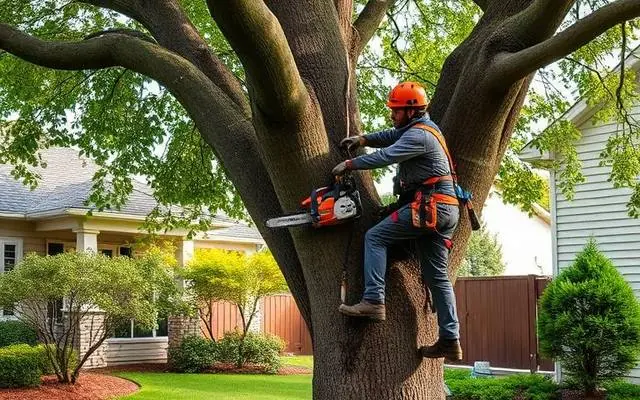
Describe the job once and independent tree service companies who service your address will come back with quotes you can compare.
How long tree services work takes, and how soon someone can come
Most residential removals are completed in a day, and pruning jobs often in a few hours. Large or complex removals near structures can take two days, particularly when a crane is scheduled.
Emergency work after storms is prioritised but availability tightens across a whole region at once. Planned work is easiest to book in late autumn and winter, when crews are less busy and deciduous trees are easier to assess without leaves.
How to choose the right arborist
Verify insurance directly, not through a business card. Ask for a certificate showing liability coverage and workers' compensation, and confirm it is current. If an uninsured worker is injured in your yard, or a limb goes through your roof, that verification is what protects you.
For anything involving tree health rather than removal, look for a certified arborist. Diagnosing decline, assessing structural risk and recommending pruning that will not harm the tree is a different skill set from cutting.
- Current liability insurance and workers' compensation certificates
- Certified arborist involvement for health and risk assessments
- A written scope stating what is removed, ground and hauled away
- Utility line clearance handled properly, some lines require the utility itself
- Confirmation of who is responsible for property protection during the work
Questions to ask before you hire a arborist
Nobody expects you to know the trade. These questions are the ones that separate a company that has thought the job through from one that is guessing on the phone.
- Are you insured, and can I see current certificates?
- How will this tree come down, in sections or felled?
- Is stump grinding included, and to what depth?
- Who hauls away the debris and logs?
- Is this tree actually hazardous, or can it be pruned instead?
- Do I need municipal permission to remove this tree?
Tell us what the job involves and compare quotes from tree service companies nearby. It costs you nothing.
Permits, rules and who is allowed to do the work
Many municipalities regulate tree removal, particularly for trees above a certain trunk diameter, on city boulevards, or with heritage designations. Permits and replanting requirements are common, and fines for unpermitted removal can be substantial.
Work near power lines is restricted. Utility-owned conductors generally require the utility or a certified line-clearing contractor rather than a general tree crew, and no homeowner should be near them.
Trees on or near property lines raise ownership questions. Where a trunk straddles the line, both owners typically have an interest, and removing it without agreement invites a dispute worth avoiding.
Seasonal timing and Canadian conditions
Late autumn and winter are excellent for most pruning and removal. Trees are dormant, structure is visible without leaves, frozen ground reduces lawn damage from equipment, and crews have more availability.
Spring and summer bring emergency work after storms and heavy foliage that makes assessment harder. Certain species should be pruned outside particular windows to reduce disease and pest risk, which an arborist will advise on.
Common mistakes that cost homeowners money
Two mistakes dominate: hiring the cheapest quote without checking insurance, and topping a tree because it seemed like a compromise between pruning and removal. Topping causes weak regrowth and usually shortens the tree's life.
- Hiring an uninsured crew for work over a house
- Topping trees instead of proper structural pruning
- Removing a protected tree without checking municipal rules
- Attempting removal of anything near a structure or line as a DIY job
- Leaving damaged limbs after a storm until the next windy night
Getting the longest life out of the work
Mature trees are assets, and they last longest with periodic attention rather than intervention only when something fails. An arborist's visit every few years is inexpensive compared with removing a tree that declined unnoticed.
- Have mature trees assessed every few years, sooner after major storms
- Prune young trees for structure early, it prevents problems decades later
- Keep mulch around the base but away from the trunk itself
- Water established trees during extended dry spells, especially newly planted ones
- Watch for dieback, fungal growth at the base and sudden leaf loss as early warnings
Where CentFix fits in
CentFix is not a tree services company. We do not send crews, set prices or hold the warranty. What we do is take one clear description of your job and put it in front of independent tree service companies who already work in your area, so you get several real quotes instead of spending an afternoon leaving voicemails.
Homeowners never pay us. The professionals you hear from run their own businesses, carry their own licensing and insurance, and stand behind their own work. Read what comes back, ask follow-up questions, and hire the one whose answers make sense to you.