Proudly Canadian
Trenchless Pipe Repair in Canada: what's involved, what it costs, and how to hire
CentFix
Updated regularly · Canada-wide
If you're looking into trenchless pipe repair, you probably want three things answered: what the work actually involves, what it's likely to cost, and how soon someone can get to it. This guide covers all three in plain language so you can have a useful conversation with a plumber instead of a guessing match over the phone.
CentFix is a matching service. You describe the job once and we route it to independent professionals who serve your address. Licences, insurance, warranties and reviews belong to the individual businesses that earned them, we connect you, they do the work.
Everything below applies across Canada and reflects how sewer and underground line work is normally handled in houses, condos and small commercial properties, including the seasonal and code realities that shape the job here.
What trenchless pipe repair covers
The sewer lateral runs from the house to the municipal main, usually under the front yard and often under the driveway or sidewalk. In most Canadian municipalities the homeowner owns and maintains it to the property line, sometimes all the way to the main. Work in this zone, including trenchless pipe repair, means locating the line, confirming its depth and condition, and then either restoring flow, repairing a section, or replacing the run.
Investigation comes first. A camera is fed through the cleanout to record condition, and a sonde in the camera head lets the crew mark the exact position and depth on the surface. That locate is what determines whether a repair is a two-metre pit in the lawn or a trench across a paved driveway, and it is the difference between a fair quote and a guess.
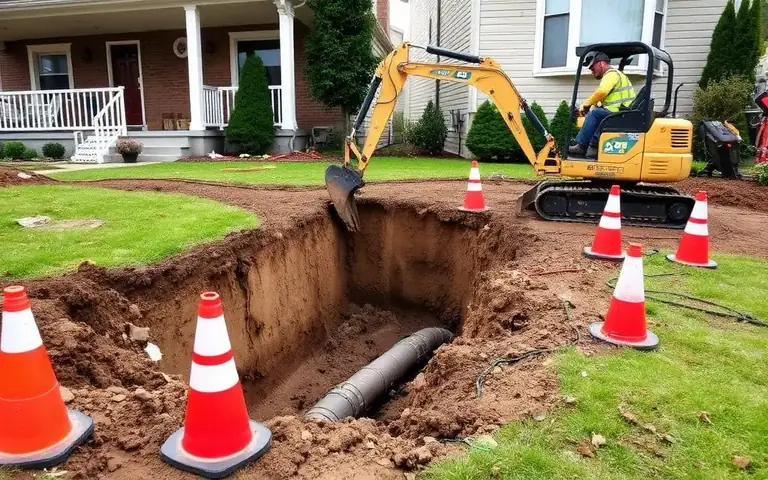
Repair method follows condition. Isolated damage is often fixed as a spot repair. A deteriorated but continuous line can sometimes be relined with a cured-in-place liner, or replaced by pipe bursting, both of which avoid a long open trench. A collapsed line, a bad slope, or a line at the wrong depth generally needs open excavation and new pipe.
- Camera inspection with recorded footage
- Surface locating and depth measurement
- Municipal locates for gas, hydro and telecom before any dig
- Spot repair, lining, pipe bursting or full replacement
- Backfill, compaction and surface restoration
Compare quotes from contractors who camera the line first and price the repair second.
Signs the underground line is the problem
Multiple fixtures backing up at once, especially the lowest ones in the house, points below the floor rather than at a fixture. A floor drain that surfaces water when the washing machine drains is a classic sign. So is a toilet that bubbles when the tub empties, air being displaced by a partly blocked line.
Outside, watch for a strip of grass over the lateral that stays greener or sinks slightly, a persistent sewage smell in the yard after rain, or a soft patch that never dries. Repeated backups on a rain schedule usually mean groundwater or roots entering through a failed joint.
Age and material matter. Homes built before the 1970s frequently have clay tile or cast iron laterals; both fail at joints and both are attractive to roots. A camera inspection before buying an older home is one of the cheapest pieces of insurance available.
What drives the cost of trenchless pipe repair
Depth and length dominate. A line one and a half metres down is a manageable dig; three metres down needs shoring, a larger machine, and more spoil to handle and haul away. Every additional metre of run adds pipe, time and restoration.
Then there's what sits on top. Lawn is the cheapest surface to open and reinstate. Interlock can often be lifted and relaid. Concrete driveways, asphalt and city sidewalks all mean cutting, disposal and new material, and work in the municipal right-of-way brings its own permit and inspection requirements.
Ask specifically what the quote includes. Permit fees, municipal locates, traffic control where the sidewalk is involved, spoil disposal, backfill material, compaction and surface restoration are all real line items, and their absence is usually why one number looks lower than another.
- Depth of the line and whether shoring is required
- Total length of pipe being repaired or replaced
- Surface above: lawn, interlock, concrete, asphalt or sidewalk
- Permits, municipal locates and inspection
- Trenchless versus open cut, where both are viable
- Restoration: what is put back, and to what standard
Timelines, permits and what happens on site
Emergency clearing can happen the same day. Planned excavation cannot, because utility locates take several business days in most provinces and are not optional; hitting a gas line is a serious incident. Budget roughly a week from decision to dig for a straightforward residential job, longer if a municipal permit is involved.
The dig itself is often quicker than homeowners expect: one to two days for a typical spot repair or short replacement, longer where depth, water table or a paved surface complicate the work. Trenchless lining can sometimes be completed in a day, with a curing period before the line returns to service.
Expect an inspection where the municipality requires one, and don't let the trench be closed before it happens. Ask for photos of the open trench and the new pipe before backfill, that record is your only view of workmanship once the ground is closed.

Choosing a contractor for underground work
This is the highest-stakes plumbing work a homeowner is likely to buy, so verify more than usual: provincial licence, liability insurance with a limit appropriate to excavation, workers' compensation coverage, and experience with your municipality's permit process specifically.
Get the diagnosis in writing with camera footage attached, then get a second quote from a company that did not do the inspection. If both agree on scope, you can buy with confidence. If they disagree sharply, that difference is worth understanding before spending five figures.
- Recorded camera footage supplied to you, not just described
- Written scope naming method, length, depth and materials
- Permit and locate responsibility stated clearly
- Restoration standard defined in the contract
- Warranty on both pipe and workmanship, in writing
Describe the property and symptoms once, and hear back from contractors who handle this work locally.