Proudly Canadian
Hot Water Tank Installation in Canada: what's involved, what it costs, and how to hire
CentFix
Updated regularly · Canada-wide
If you're looking into hot water tank installation, you probably want three things answered: what the work actually involves, what it's likely to cost, and how soon someone can get to it. This guide covers all three in plain language so you can have a useful conversation with a plumber instead of a guessing match over the phone.
CentFix is a matching service. You describe the job once and we route it to independent professionals who serve your address. Licences, insurance, warranties and reviews belong to the individual businesses that earned them, we connect you, they do the work.
Everything below applies across Canada and reflects how water heater work is normally handled in houses, condos and small commercial properties, including the seasonal and code realities that shape the job here.
What hot water tank installation involves
Water heating is the second largest energy use in most Canadian homes, and hot water tank installation touches gas or electrical supply, venting, water connections and safety devices all at once. That's why it's regulated work: a gas unit requires a licensed gas fitter, an electric unit requires proper circuit sizing, and both require correct relief valve and drain arrangements.
A proper visit starts with assessment rather than a part swap. The plumber checks the data plate for age and capacity, looks at the anode rod and tank base for corrosion, tests the thermostat and elements or the burner and thermocouple, and inspects the venting on a gas unit for backdraft. Some faults, a failed element, a dead thermocouple, a stuck relief valve, are worth repairing. A tank with a corroded shell is not.
Where replacement is the answer, the decision splits three ways. A conventional tank is the cheapest to install and the simplest to service. Tankless delivers unlimited hot water and saves space, but needs a larger gas supply and dedicated venting, so installation costs more. Heat-pump water heaters are efficient and increasingly rebate-eligible, but they need enough surrounding air volume and a drain for condensate.
- Assessment of age, corrosion, controls and venting
- Repair where the tank shell is sound
- Correct sizing to household demand, not just like-for-like
- Gas, electrical, venting and relief valve compliance
- Removal, disposal and permit where required
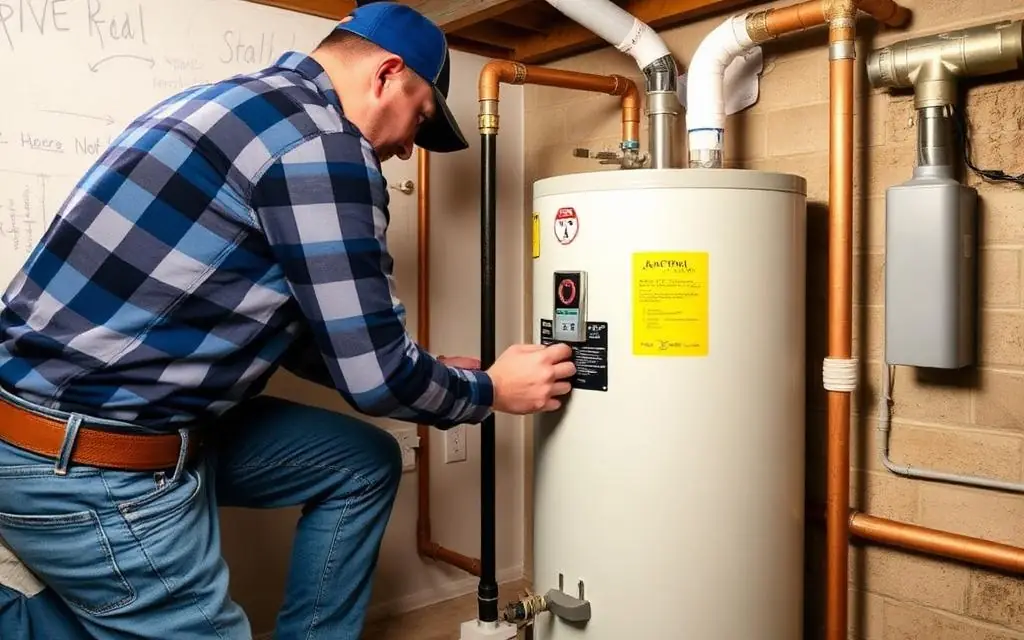
Describe your setup and compare quotes for hot water tank installation from licensed local plumbers.
Repair or replace, and how to tell
Age is the first filter. Conventional tanks typically last eight to twelve years in Canadian water conditions, less in hard-water areas without maintenance. A five-year-old tank with a failed element is a repair. An eleven-year-old tank with the same fault is a replacement waiting a few months.
Water on the floor is the deciding symptom. If it comes from a fitting, the relief valve or the drain valve, it's fixable. If it's seeping from the tank seam or the base, the inner shell has corroded through and no repair exists. Rusty hot water and a sulphur smell point at the anode rod and the tank lining rather than the plumbing.
Running cost belongs in the comparison. An inefficient old unit quietly spends money every month, and rebate programs in several provinces offset the cost of higher-efficiency replacements. Ask what's available where you live, and ask whether the installer handles the paperwork.
What affects the price of hot water tank installation
Equipment is only part of the number. Capacity, fuel type and efficiency set the unit price; the installation is priced separately and varies far more. A straight tank-for-tank swap in an open basement with existing connections is the simplest scenario there is.
Conversions cost more for good reasons. Moving from tank to tankless usually means a new gas line size, new stainless venting through an exterior wall, a condensate drain and often an electrical outlet. Moving location adds pipe runs. A tight stairwell or a finished mechanical room can turn removal of the old unit into a two-person job.
Then there's the paperwork and the extras: permit and inspection where the municipality requires them, an expansion tank or thermal expansion control where the system is closed, a new shutoff valve, a drain pan with a piped outlet, and disposal of the old tank. Ask which of those are in the quote.
- Tank size, fuel type and efficiency rating
- Like-for-like swap versus conversion or relocation
- Gas line sizing and venting requirements
- Access: basement stairs, crawl space, closet installs
- Permit, inspection, expansion control and disposal
Timelines and what happens on install day
A standard tank replacement is a half-day job, typically two to four hours including draining the old unit. Tankless installation is usually a full day, sometimes two where gas and venting need rework. Emergency replacements can often be done same day if the unit is a common size held in stock.
Clear a path from the door to the unit before the crew arrives and move anything stored nearby. Water will be off for part of the visit, and on a gas unit the supply is shut and relit at the end. Expect the installer to test the relief valve, check for gas leaks at every joint, verify draft on the vent, and set the thermostat to a safe temperature.
Keep the paperwork: model and serial number, install date, warranty registration and the permit or inspection record. Manufacturer warranties on tanks are commonly six to twelve years, but many require registration and proof of professional installation to be honoured.
Choosing the right installer
For gas equipment, confirm gas fitter certification as well as the plumbing licence. For electric, confirm the circuit will be verified rather than assumed. Ask whether the installer pulls a permit; in many municipalities the work requires one and an uninspected install can complicate an insurance claim later.
Ask about the rental question directly if your current tank is rented. Buyout terms, removal, and who notifies the rental company are all worth settling before install day rather than discovering afterwards that the old unit still belongs to someone else.
- Plumbing licence plus gas fitter certification for gas units
- Permit and inspection handled by the installer
- Written scope: unit model, venting, valves, disposal
- Separate labour and equipment warranties, in writing
- Rebate eligibility and who submits the application
One description, several prices from licensed installers who serve your address.