Proudly Canadian
Heated Driveway in Canada: what's involved, what it costs, and how to hire
CentFix
Updated regularly · Canada-wide
If you're looking into heated driveway, you probably want three things answered: what the work actually involves, what it's likely to cost, and how soon someone can get to it. This guide covers all three in plain language so you can have a useful conversation with a plumber instead of a guessing match over the phone.
CentFix is a matching service. You describe the job once and we route it to independent professionals who serve your address. Licences, insurance, warranties and reviews belong to the individual businesses that earned them, we connect you, they do the work.
Everything below applies across Canada and reflects how radiant heating work is normally handled in houses, condos and small commercial properties, including the seasonal and code realities that shape the job here.
How heated driveway works
Radiant heating warms surfaces rather than air, and the surfaces then warm everything in the room. That's why a radiant space feels comfortable at a lower thermostat setting than a forced-air one. Heated Driveway comes in two forms: hydronic, circulating warm water through tubing, and electric, using resistance cable or mats.
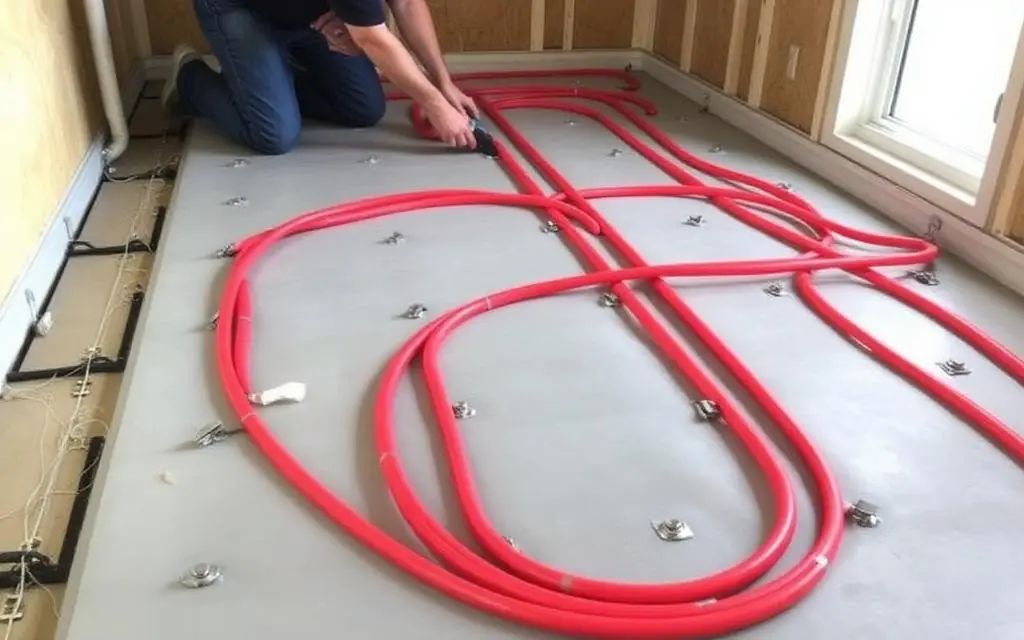
Hydronic suits larger areas and whole-home heating. It needs a heat source (boiler, combi unit or heat pump), a manifold, circulators, mixing valves to protect the floor assembly from over-temperature water, and zone controls. Installation is more involved and the running cost per unit of heat is generally lower.
Electric suits smaller areas, bathroom and kitchen floors especially, and retrofits where build-up height is limited. Mats go down over a suitable substrate, under tile or engineered flooring, with a dedicated circuit and a floor-sensing thermostat. Installation is straightforward; operating cost per square metre is higher, which is why it's used for comfort zones rather than whole houses.
- Heat loss calculation for the space
- Hydronic tubing and manifold, or electric mat layout
- Floor assembly, insulation below, and build-up height
- Mixing valves and zone controls for hydronic systems
- Dedicated circuit and floor sensor for electric systems
- Pressure or resistance testing before covering
Compare quotes for heated driveway from experienced local installers.
Driveways, walkways and snow melting
Exterior radiant systems keep driveways and walkways clear through the winter, which matters for steep drives, accessibility, and liability at commercial entrances. The same two technologies apply, hydronic loops in the slab, or electric cable, with hydronic dominating for larger areas because of running cost.
The work has to be planned with the paving, not after it. Tubing or cable is placed in the base and secured before concrete or asphalt goes down, with proper depth and spacing. Sensors detect both temperature and moisture so the system runs only when there's something to melt, which is what keeps operating costs reasonable.
Expect a genuine capital cost. In return you get no shovelling, no salt damage to concrete and landscaping, and a surface that's safe through freeze-thaw cycles. It's most often specified for new construction, major driveway replacement, or steep and hazardous approaches.
What drives the cost of heated driveway
Area is the base measure, then system type. Electric mats in a small bathroom are a modest addition to a tile job. Hydronic in a basement slab is a bigger project involving a heat source, manifold and controls. Retrofitting into an existing floor is the expensive scenario, since the floor covering has to come up and build-up height becomes a constraint.
Insulation under the heated surface has an outsized effect on both cost and performance. Skipping it saves a little at install and wastes heat downward forever. Any competent design includes it, and for slab-on-grade it's not optional.
Controls and zoning add cost and pay it back in comfort and running expense. Separate zones let you heat the bathroom floor in the morning without running the whole basement, and a programmable floor-sensing thermostat keeps electric systems from running longer than needed.
- Heated area and system type, hydronic or electric
- New construction versus retrofit into an existing floor
- Heat source: existing boiler, new combi unit, or heat pump
- Insulation below the heated assembly
- Zoning, controls and sensors
- Electrical work: dedicated circuits and panel capacity
Installation and commissioning
Electric mats in a single room are usually a one-day install ahead of tiling. Hydronic in a slab is placed and tested before the pour, then connected once the mechanical room is ready. Exterior snow-melt work is tied to the paving schedule and has to be coordinated well in advance.
Testing before covering is non-negotiable. Hydronic loops are pressure tested and left under pressure during the pour so any damage shows immediately. Electric cable resistance is measured before, during and after installation, and the readings should be recorded on the warranty documentation.
Radiant systems respond slowly by design. A floor takes hours to come up to temperature and hours to cool, so setback schedules that work for forced air don't apply. Expect the installer to explain the control strategy and to set it up for you rather than leaving a manual on the counter.
Choosing an installer
Ask whether a heat loss calculation is part of the design. Systems sized by rule of thumb either underperform on cold days or run at temperatures the floor covering can't tolerate. For hydronic work, ask how the water temperature is limited and controlled.
Coordination is half the job. Confirm who talks to the flooring installer, the concrete contractor and the electrician, and get the sequence written down. Confirm also that the floor covering you've chosen is rated for use over radiant heat, since some engineered products have temperature limits.
- Heat loss calculation and documented design
- Testing records before and after covering
- Floor covering compatibility confirmed in writing
- Coordination sequence with other trades
- Warranty on both cable or tubing and workmanship
Describe the space once and get quotes back from installers who serve your area.