 Proudly Canadian
When an Electrical Panel Upgrade Is Worth It
Breaker trips, older service sizes and what an electrician looks at.
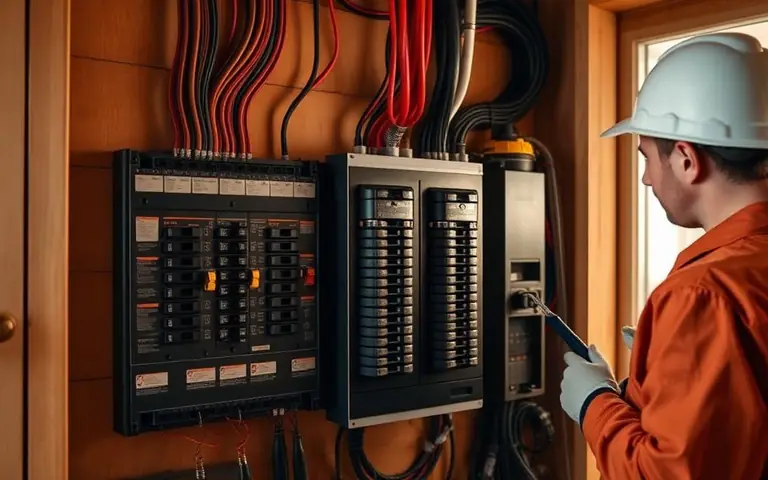
An electrical panel upgrade is one of those projects nobody wants to pay for, because when it's finished the house looks exactly the same. But the panel is the point where every circuit in the home is protected, and older ones weren't designed for the load a modern household puts on them.
Here's how to tell whether you genuinely need one, what an electrician actually looks at, and what it costs.
What service size you have, and why it matters
Service size is the total current the utility feed and panel can deliver. Older Canadian homes commonly have 60 amp service. Homes from the 1960s through the 1990s are often 100 amp. Newer or renovated homes are usually 200 amp.
Sixty amps was adequate when a house had lighting, a fridge, a stove and not much else. Add central air, a heat pump, an electric dryer, a hot tub, a workshop or an EV charger and the math stops working. Many insurers now refuse or surcharge policies on 60 amp service, and some lenders raise questions at purchase.
One hundred amps still suits a lot of homes, particularly gas-heated ones with a gas stove and dryer. It becomes a constraint when you add electric heating, a large air conditioner, or a level 2 EV charger. Two hundred amps is the current default for new construction and gives room for electrification later.
You can find your service size on the main breaker, it'll read 60, 100, 125 or 200. If the panel has fuses rather than breakers, you almost certainly have older service.
Signs that point to a panel problem
A single circuit tripping is usually a circuit problem, too many things plugged in, a faulty appliance, or a fault in the wiring. That's a repair, not a panel upgrade. It's the main breaker tripping, and heat or smell at the panel, that point at the service itself.
- Breakers that trip repeatedly on the same circuit, or trip with no obvious load.
- A main breaker that trips when several large appliances run together.
- Lights that dim noticeably when the furnace, AC or a big motor starts.
- Warm or discoloured breakers, a burning smell, or a buzzing panel.
- Rust inside the enclosure, or visible corrosion on the bus bars.
- A panel that's completely full, with tandem breakers doubled up everywhere.
- Fuses instead of breakers, or a panel with no room for AFCI and GFCI devices.
Panels with known histories
Some older panel brands have a poor reputation for breakers that fail to trip under fault conditions. Federal Pacific Stab-Lok panels are the most frequently cited, and Zinsco and Sylvania panels come up as well. Home inspectors flag them routinely, and some insurers will require replacement or charge more.
If you have one, have an electrician assess it. Replacement of the panel alone, keeping the same service size, is a smaller and cheaper job than a full service upgrade, and it resolves the insurance question.
Aluminum wiring and knob-and-tube
Two other findings often surface at the same time. Aluminum branch wiring, common in Canadian homes built roughly between the mid-1960s and mid-1970s, isn't inherently unsafe but requires properly rated devices and connections. Insurers usually want a certified inspection and remediation at connection points.
Knob-and-tube wiring is older still, has no ground, and is often derated by insulation added around it later. Most insurers won't write a policy on a home with active knob-and-tube.
Neither is fixed by replacing the panel. They're separate wiring projects, and it's worth knowing that before you assume a new panel solves your insurance problem.
What an electrician looks at
A proper assessment starts with a load calculation, adding up the connected load, heating, water heating, range, dryer, air conditioning, EV charging, and applying the code's demand factors to determine what service size the house actually requires.
They'll also inspect the service entrance, the meter base, the mast and how the feed enters the building, the grounding and bonding, the condition of the bus and breakers, and whether the panel location still meets clearance requirements. On a rural property, they'll look at the transformer capacity too.
The result should be a written recommendation with a reason, not just "you need 200 amps." If you're planning an addition, a heat pump or an EV, say so up front, since that changes the calculation.
What it costs
A panel swap keeping the same service size, replacing an obsolete panel with a modern one, typically runs $1,500 to $3,000.
A full service upgrade from 60 or 100 amp to 200 amp usually falls between $2,500 and $5,000, and can exceed that when the mast, meter base and service conductors all need replacing, when the utility has to change the drop, or when the run from the meter to the panel is long or difficult.
Costs that add up on top: relocating the panel, replacing an underground service lateral, upgrading the grounding electrode, adding AFCI or GFCI breakers where code now requires them, and drywall repair afterward. Permit and utility disconnect fees also apply.
The work requires a permit and an inspection everywhere in Canada, and in most provinces only a licensed electrical contractor can pull it. Ask for the permit number.
The day itself
Expect the power to be off for most of a day, typically six to eight hours, sometimes across two visits if the utility has to schedule a disconnect and reconnect separately. Plan for the fridge and freezer, and for anyone working from home.
The electrician will land each existing circuit on the new panel, label everything properly, install the required arc-fault and ground-fault protection, and verify grounding and bonding. An inspector signs off afterward, sometimes days later.
When it's worth doing even if nothing is broken
Three situations make an upgrade a reasonable pre-emptive investment. First, if you're planning to add electric heating, a heat pump, or an EV charger, doing the panel first avoids doing the work twice. Second, if you're already renovating and the walls are open, the incremental cost of running new feeds is much lower. Third, if you're preparing to sell and the panel is one of the flagged brands or sits at 60 amps, it's a known objection that reduces offers.
If none of those apply, your panel is modern, the service is 100 amps or more, nothing trips, and there's room for expansion, then there's no urgency. An upgrade in that case buys capacity you may never use.
Common questions
Not always. A level 2 charger typically needs a 40 to 60 amp circuit, and whether 100 amp service can support it depends on your other loads. A load calculation answers it, and load-management devices can sometimes avoid an upgrade entirely.
Most are a single day of work, with power off for roughly six to eight hours. Utility scheduling and the inspection can stretch the overall timeline across a week or two.
No. Service work is licensed in every province, requires a permit and inspection, and involves conductors that remain live ahead of the main. This is not a DIY category.
No. Service size determines capacity, not consumption. What it can do is reduce nuisance tripping, remove an insurance obstacle, and let you add equipment safely.